

Why SMS delivery is broken: routing, grey routes and the trust problem (Twilio alternative explained)
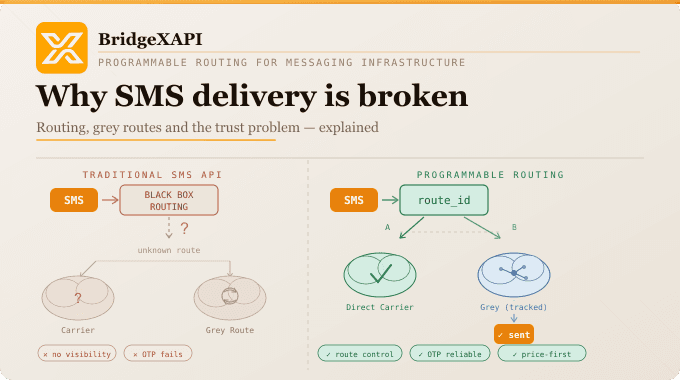
SMS delivery issues explained: grey routes, hidden routing and why OTP messages fail. Learn how programmable routing solves it.
Most developers think SMS delivery is reliable.
It is not.
Messages get delayed.
OTP codes arrive too late.
Sometimes they don’t arrive at all.
And the reason is almost never your code.
It’s routing.
The hidden layer behind SMS delivery
Most SMS APIs expose messaging.
They do not expose routing.
When you send a message:
you don’t know which route is used
you don’t know if it’s direct or grey
you don’t know why delivery fails
A system makes these decisions for you.
This is the black box.
The real issue: grey routes
In many systems, messages are not sent over direct carrier connections.
They are forwarded.
Sometimes across multiple intermediaries.
These are often referred to as "grey routes".
They exist for one reason:
cost.
But they come with trade-offs:
unstable delivery
unpredictable latency
filtering or blocking
OTP unreliability
This is one of the main reasons developers lose trust in SMS.
The current model
Platforms like Twilio provide powerful messaging APIs.
You define:
the message
the destination
The system decides:
routing
pricing
fallback behavior
In most cases, this works.
But when delivery becomes critical (OTP, authentication, payments),
lack of routing visibility becomes a limitation.
A different approach: programmable routing
There is a different model.
Programmable routing.
Instead of abstracting delivery, it exposes it.
You control:
route_id
pricing before execution
delivery tracking per route
Example:
from bridgexapi import BridgeXAPI

client = BridgeXAPI(api_key="YOUR_API_KEY")

client.send_sms(
    route_id=3,
    caller_id="BRIDGEXAPI",
    numbers=["31612345678"],
    message="Your OTP code is 4821"
)
The route is explicit.
Nothing is hidden.
Why this matters
In real systems:
OTP delivery is time-sensitive
cost varies per route and destination
failures happen at the carrier level
Without routing control:
you cannot debug delivery
you cannot optimize cost
you cannot guarantee reliability
Messaging is not the system.
Routing is.
Closing
The problem with SMS is not messaging.
It’s hidden routing.
Until routing becomes visible and controllable,
SMS will continue to feel unreliable.
More: https://docs.bridgexapi.io
https://github.com/bridgexapi-dev